Inspired by Maurice Sendak’s, ’Where the Wild things are’, this imaginative journey takes pupils on mini adventures that explore the animal kingdom to create fantastical creatures.
Where The Wild Things Live from Manchester Art Gallery on Vimeo.
Maurice Sendak’s, “Where the Wild Things Are”, is read to the children and the opposing concepts of wild and tame, imagination and reality are discussed.
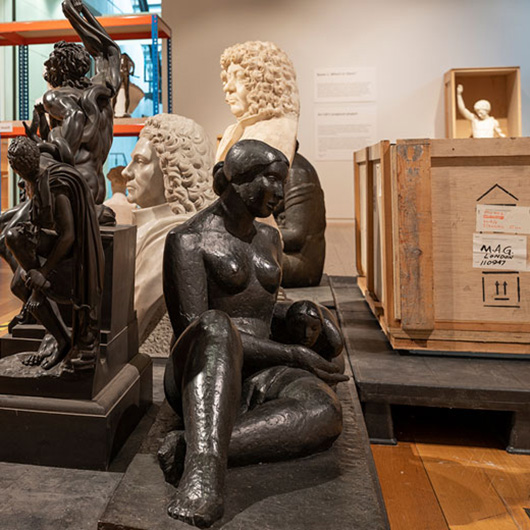
The children look at paintings and sculptures of ‘Wild Things’ and collect and draw ideas for their puppets.
The pupils have the opportunity to use an Interactive Whiteboard to further explore and develop ideas for their puppets using images created by Jim Medway.
They create their own ‘Wild Thing’ puppets using a variety of resources and use their puppets to act out the poem “Let’s Make a Rumpus”, joining in with actions, sounds and words.
If possible, children should be able to name animal body parts and understand the difference between wild and tame, and between real and imaginary, before their visit to the art gallery.
For more information including booking, parking, facilities and a downloadable risk assessment, please go to plan your visit.
ArtChildren are encouraged to observe and draw examples of shapes, patterns, and textures in paintings and sculptures in the galleries. They select elements of drawings by Jim Medway using the interactive whiteboard to create a composite ‘Wild Thing’. They develop cutting, tearing and sticking skills using a variety of resources to make a collage paper plate puppet.
Children use listening and speaking skills when the story, “Where the Wild Things Are”, is read and discussed.
They extend and develop their vocabulary when discussing the paintings and sculptures in the galleries.
Children enjoy the rhythm and rhyming words of the poem “Let’s Make a Rumpus”, when enacting the ‘rumpus’ with their ‘Wild Thing’ puppets.
Children are encouraged to consider the differences between acceptable behaviour and unacceptable behaviour, wild and tame, control, lack of control and self-control.
Children use the interactive whiteboard in a creative manner to select, drag and rotate images in order to create a composite figure.
Children use a variety of movements to illustrate actions in the poem such as stomping, prancing and dancing.
This is a new format that we are trialling for Pre-Visit notes. We would love to get your feedback. Did you find this useful or is there anything that you think is missing that should be there? Please contact us with your thoughts at:
Email: mageducation@manchester.gov.uk.